Is It Illegal for a Roofing Contractor to Waive Your Insurance Deductible in Texas?
September 16, 2026
Your roof is one of the most vital components of your home, providing protection against the elements and contributing significantly to your property's curb appeal. However, like any part of your home, roofs don't last forever. Knowing the signs that indicate it's time for a roof replacement can save you from costly repairs or potential damage to your home. At Elevated Roofing and Construction in Amarillo, TX, we are your trusted partners in determining when a roof replacement is necessary. Below, we outline key indicators that it might be time to replace your roof.
1. Age of Your Roof
The longevity of a roof largely depends on the materials used. Asphalt shingle roofs typically last 20-25 years, while metal roofs can last longer. If your roof is nearing the end of its lifespan, it's wise to start considering a replacement. Proactively replacing an aging roof can prevent leaks and structural damage.
2. Frequent Repairs
If you're constantly calling for repairs, it might be more cost-effective to replace the entire roof. Ongoing repairs can add up and still leave you with an unreliable roofing system. Our team can help you weigh the cost of repairs versus a new roof to make the best decision for your home.
3. Visible Shingle Damage
Inspect your roof periodically for signs of wear and tear. Look for shingles that are curled, cracked, or missing altogether. These are signs that your shingles have reached the end of their life cycle and are no longer providing the protection your home needs.
4. Roof Leaks and Water Damage
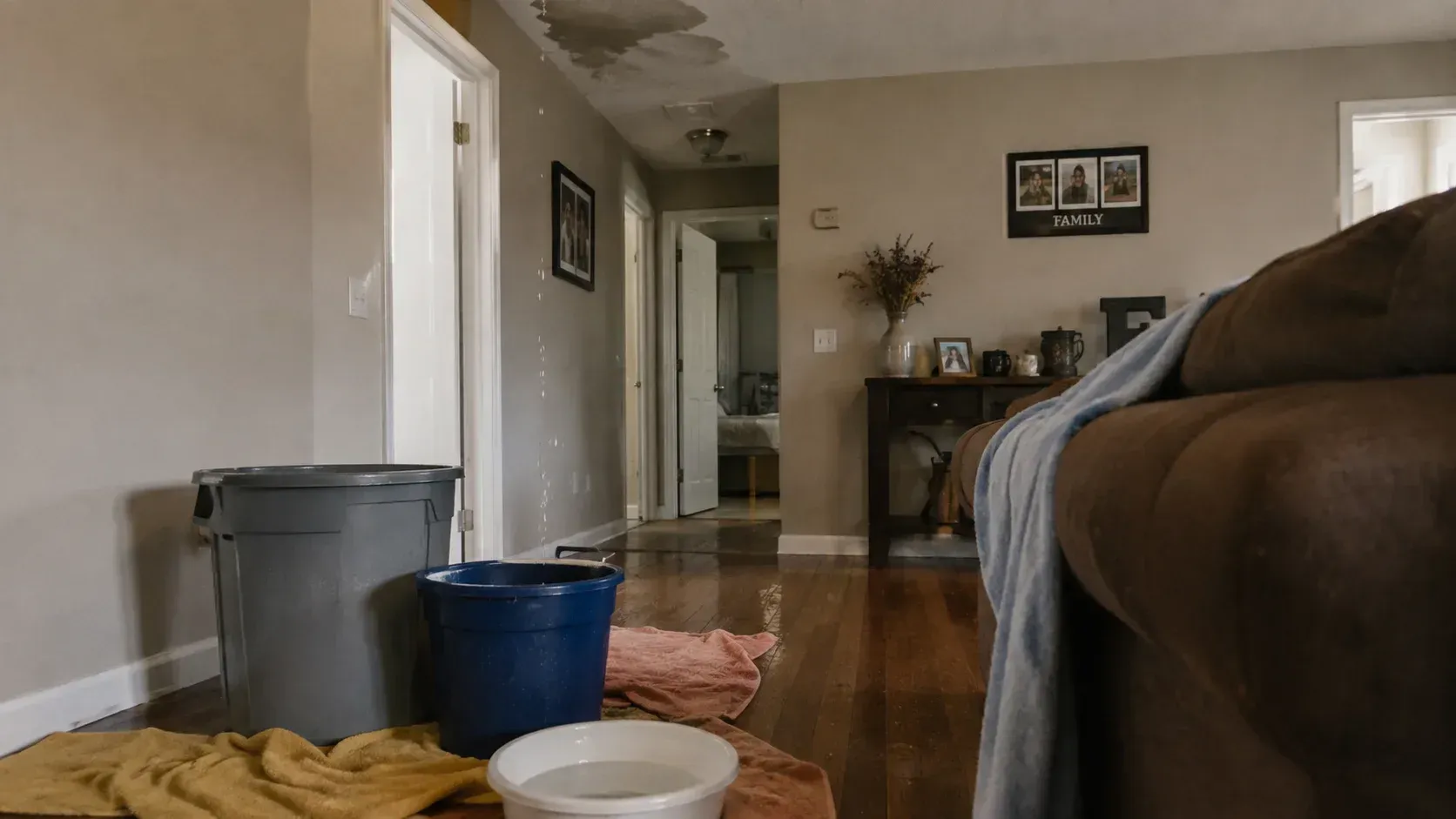
Water stains on ceilings or walls inside your home are clear indicators of a roof leak. If you've noticed water damage or signs of mold and mildew, it's critical to address the issue immediately to prevent further damage to your home’s interior.
5. Sagging Roof
A sagging roof is a serious issue that indicates structural problems. If you notice any part of your roof sagging, it's crucial to address it immediately to prevent further structural failure. This often requires a full roof replacement to ensure your home’s safety.
6. Granules in Gutters
As shingles age, they lose their granules, which often end up in your gutters. If you notice a significant amount of granules in your gutters, it could be a sign that your shingles are deteriorating and need replacing.
7. Increased Energy Bills
A well-insulated roof can help regulate your home's temperature. If you've noticed an unexplained increase in your energy bills, your roof might not be insulating effectively. This can often be mitigated by a new roof with better insulation properties.
8. Moss or Algae Growth
While moss and algae growth can sometimes be cleaned off, persistent growth might be a sign that moisture is being trapped in your roof, which can lead to structural damage. If moss and algae are constantly reappearing despite cleaning, a roof replacement might be necessary.
9. Storm Damage
After severe weather events, like hailstorms or high winds, it's essential to inspect your roof. Storm damage can be extensive and often requires professional evaluation. Elevated Roofing and Construction can inspect your roof for damage and recommend whether repairs or a full replacement are needed.
10. Sunlight through Roof Boards
If you can see sunlight shining through your roof boards in the attic, it's a clear indication that your roof has holes or gaps. This type of damage allows in water and pests, necessitating an urgent replacement.
Act Now to Protect Your Home
If you've noticed any of these signs, it's crucial to contact a professional roofing company that can provide a thorough evaluation. Delaying roof replacement can lead to significant structural damage and costly repairs down the line. Elevated Roofing and Construction is here to assist you every step of the way, offering expert assessment and high-quality roof replacement services in Amarillo, TX, and surrounding areas.
Why Choose Elevated Roofing and Construction?
Our experienced team is dedicated to providing superior craftsmanship and exceptional customer service. We use only premium materials and advanced techniques to ensure your new roof stands the test of time. Plus, we work closely with your insurance company to make the process as seamless as possible.
Don't wait until a minor roofing issue becomes a major problem. Contact Elevated Roofing and Construction today to schedule your roof inspection. Visit our website at www.elevatedroofingtx.com or call us at (806) 738-4082. Let us help you protect your home with a reliable and beautiful new roof. Your dream roof is just a call away!
Table of Contents
- Introduction
- What Texas Law Says About Waiving an Insurance Deductible
- Why the Deductible Waiver Roofing Scam Costs You More Than It Saves
- How the Offer Usually Gets Worded
- What Happens to You, Not Just the Contractor
- Storm Chaser Insurance Fraud in Texas: The Pattern After Every Hailstorm
- Questions to Ask Any Roofing Contractor After a Storm
- What a Legitimate Contractor Does With Your Claim Instead
- If You Already Signed One of These Contracts
- Conclusion
- Request a Documented Storm Damage Inspection
- Frequently Asked Questions
Key Takeaways
- It is illegal in Texas. A contractor cannot pay, waive, rebate or absorb any part of your insurance deductible as an inducement to sign, and the prohibition sits in the Texas Insurance Code.
- The offer is not a discount. Your deductible is your share of a covered loss, so a contractor who covers it has to recover the money somewhere, usually by inflating the claim.
- An inflated claim exposes you, not only the contractor. You are the named insured who signed and submitted it.
- The law also requires contractors to tell you in writing that you are responsible for paying your deductible. A contract missing that notice is a warning sign.
- Legitimate storm work looks different: a documented inspection, an itemized scope, the contractor present at the adjuster's visit, and you paying your deductible.
Introduction
No, a roofing contractor cannot legally waive your insurance deductible in Texas. State law prohibits a contractor from paying, rebating, absorbing or otherwise offsetting any part of a property insurance deductible as an inducement to sign a repair contract, and it also requires that your contract state in writing that you are responsible for paying it. If someone knocking on your door after a hailstorm offers to "eat the deductible" or "make it disappear," they are proposing something the law does not allow.
We do a lot of storm work, and our roof repair crews hear about this offer constantly in the weeks after Panhandle hail. It is worth understanding why the rule exists, because the reasoning explains why the offer is bad for you specifically, not just legally awkward for the contractor.
Below is what the law actually prohibits, how the offer usually gets dressed up, and what your exposure looks like if you accept it.
What Texas Law Says About Waiving an Insurance Deductible
Texas addressed this directly. The prohibition covers more than just handing you cash for the deductible amount. In broad terms, a contractor may not:
- Pay your deductible on your behalf, directly or through a third party
- Rebate, credit or refund the deductible amount back to you after the fact
- Absorb it into the price by quietly writing the job so the deductible never gets collected
- Advertise or promise any of the above as a way to win the contract
The reach of the rule is the part people miss. It is not only the act of covering the deductible that is prohibited. Advertising or offering to do it is itself the problem, which is why "we'll waive your deductible" on a yard sign or a door hanger is a regulatory issue before any work has even started.
There is a second requirement that works in your favor as a homeowner. Texas requires roofing and repair contracts tied to an insurance claim to carry a written notice telling you that you are responsible for paying your deductible. When we look at a contract someone else wrote and that notice is missing, it tells us something about who wrote it.
We are a roofing company and not a law firm, so treat the above as the general shape of the rule rather than legal advice. If you are already in a dispute over a signed contract, talk to an attorney or contact the Texas Department of Insurance.
Why the Deductible Waiver Roofing Scam Costs You More Than It Saves
Here is the part that matters more than the legality, because it is where homeowners actually get hurt.
Your deductible is your contractual share of a covered loss. It is not a fee the contractor charges you and it is not negotiable between you and the roofer, because it exists in the agreement between you and your insurer. So when a contractor promises to cover it, that money does not come out of nowhere. It has to come from somewhere, and there are only a few places it can come from:
- An inflated claim. The most common route. The scope submitted to your insurer gets padded so the settlement covers the roof plus the deductible the contractor promised to eat. That is insurance fraud, and your signature is on the claim.
- Reduced scope or materials. You get the roof, but with cheaper underlayment, fewer fasteners, skipped flashing details or no ice-and-water barrier where it belongs. You will not know for several years.
- Skipped work you cannot see. Decking not replaced where it should be, ventilation left alone, penetrations resealed rather than properly reflashed.
- The contractor disappears. They collect the insurance payment, do partial work or none, and are three counties away before you notice. There is nobody left to honor a warranty.
In every one of those cases you paid the deductible anyway. You just paid it in roof quality, in a fraudulent claim with your name on it, or in a repair you have to do again in five years.
How the Offer Usually Gets Worded
Almost nobody says "I will illegally waive your deductible." The offer arrives in softer language, and these are the phrasings we hear repeated back to us most often:
- "We'll cover your deductible."
- "You pay nothing out of pocket."
- "Your insurance pays for everything."
- "We'll work with whatever the insurance gives us."
- "We'll write it up so the deductible is included."
- "We give a storm discount that just happens to match your deductible."
- "Sign today and we'll take care of the deductible for you."
That last category is the slipperiest, because a discount that happens to equal your deductible is functionally the same thing as covering it. The substance of the arrangement matters more than the wording on the contract.
One clarification worth making, since it comes up: a genuine, openly stated discount that is not tied to your deductible amount and not offered as a way to offset it is a different thing entirely. Legitimate contractors run promotions. The problem is specifically an inducement structured to make your deductible obligation go away.
What Happens to You, Not Just the Contractor
Homeowners often assume this is the contractor's legal problem. It is worth being blunt about your own position.
You are the named insured. You signed the claim and you submitted it. If the scope submitted to your carrier was inflated to absorb your deductible, the misrepresentation went to your insurer under your name, and the fact that a contractor talked you into it does not remove you from the paperwork.
The realistic consequences to you include:
- Claim denial. The carrier can deny the claim outright, leaving you with a damaged roof and no settlement.
- Policy cancellation or non-renewal, which makes coverage harder and more expensive to replace.
- Repayment demands for amounts already paid out.
- Fraud exposure. In serious cases the carrier can refer the matter, and insurers maintain industry-wide claim databases.
- No warranty and no recourse. A contractor operating this way is usually not around to stand behind the work.
Set against saving the amount of one deductible, that is a poor trade.
Storm Chaser Insurance Fraud in Texas: The Pattern After Every Hailstorm
We see the same sequence play out after every significant hail event in the Panhandle, and it is recognizable once you know the shape of it.
Out-of-area crews arrive within days, sometimes hours, of a storm. They canvass door to door in the neighborhoods that took the worst of it. The pitch is urgency: your neighbors have already signed, the insurance money is limited, the crews are leaving next week. The deductible offer is the closer. What gets presented as a contract is frequently an authorization to inspect or a letter of intent that assigns them rights to your claim, which is a very different document from a scope and a price.
The markers that separate a storm chaser from a local contractor are not subtle:
- No local physical address, or an address that turns out to be a mailbox or a motel
- Out-of-state plates and a phone number that is not local
- Pressure to sign immediately, on the spot, before you have a number
- No itemized scope of work, just a promise to work with the insurance
- A vague document that authorizes them to deal with your carrier rather than a contract to do specific work for a specific price
- The deductible offer itself, which is the single clearest signal
- No verifiable license, bonding or insurance you can actually check
- No reviewable local work history
None of that means every out-of-town crew is dishonest. It means the burden of proof is on anyone you have never heard of who showed up in your driveway after a storm.
Questions to Ask Any Roofing Contractor After a Storm
Ask these before you sign anything. A legitimate roofing contractor will answer all of them without hesitation, and we would rather you asked us than not:
- Are you licensed, bonded and insured, and can I see the documentation? Ask for certificates, not assurances.
- What is your physical local address, and how long have you worked in this area?
- Will you give me an itemized scope of work with quantities and materials before I sign?
- Am I responsible for paying my deductible? The answer should be an immediate yes. Anything else ends the conversation.
- Does this contract contain the required written notice about my deductible?
- Is this document a contract to do work, or an authorization involving my insurance claim? Read what you are actually signing.
- Will someone from your company be present when the adjuster inspects?
- Who honors the workmanship warranty, and where will you be in five years?
- Can I see recent local projects and reviews?
If any answer is evasive, that is your answer.
What a Legitimate Contractor Does With Your Claim Instead
Handling a storm claim properly is not complicated. It is just less dramatic than a promise to make your deductible disappear. Our insurance claims process runs the way it should:
- A professional inspection first, so the claim is based on documented findings rather than a guess from the driveway.
- Real documentation. Photographs, written damage reports and cost estimates you and your adjuster can both read. We provide expert inspections to accurately assess damage and gather the evidence that supports a claim.
- You review your own policy, including your coverage details, your deductible and your exclusions, before anything is submitted.
- We are present at the adjuster's visit. This matters more than most homeowners expect, because it is where discrepancies between what the adjuster saw and what is actually damaged get clarified on the spot.
- An honest look at the settlement offer, and a discussion if the scope is short.
- You pay your deductible, and the claim reflects the actual loss.
That process does not require anyone to bend a rule, and it produces a roof and a claim that both hold up.
If You Already Signed One of These Contracts
If you are reading this after signing something, do not panic, but do act.
Read the document carefully and find out whether it is a contract for work or an assignment of your insurance claim. Check whether it contains the deductible notice. Look for a cancellation window, since many contracts include one and Texas provides cancellation rights in some circumstances tied to insurance claims. Put any cancellation in writing and keep proof of when you sent it.
Then contact your insurance carrier or agent directly and tell them plainly what was proposed. Carriers deal with this constantly and would generally rather hear it from you early than discover it later. If money has already changed hands or you are being pressured, talk to an attorney, and you can file a complaint with the Texas Department of Insurance.
You can also simply get a second opinion. We are happy to look at a scope somebody else wrote and tell you what we see, whether or not you hire us.
Conclusion
A contractor offering to waive your insurance deductible in Texas is offering to do something the law prohibits, and the reason the law prohibits it is that the money has to come from somewhere. In practice it comes from an inflated claim submitted under your name, from materials and labor quietly removed from your roof, or from a crew that is gone before the first hard rain.
Your deductible is the one part of a storm claim that is genuinely yours to pay. A contractor who tells you that plainly, gives you an itemized scope, shows up for the adjuster and puts the required notice in the contract is telling you something useful about how the rest of the job will go.
Request a Documented Storm Damage Inspection
If Panhandle hail or wind has hit your roof, get a documented inspection from a contractor you can still find next year. Elevated Roofing and Construction is fully licensed, bonded and insured, and our team members bring over 20 years of combined experience to every assessment.
We will inspect the roof, document what we find with photographs and a written report your adjuster can use, give you an itemized scope, and be there when the adjuster comes out. We will also tell you plainly that you are responsible for your deductible, because that is how this is supposed to work.
We serve Amarillo, Borger, Canyon, Dalhart, Dumas, Pampa, Bushland and Plainview, plus the surrounding area within a 70 mile radius. Call
(806) 738-4082 or reach us through the contact page. You can see recent local work in our
gallery and read what Panhandle homeowners say in our
reviews.
Frequently Asked Questions
Can a roofing contractor legally give me a discount that happens to equal my deductible?
If the discount is structured to offset your deductible obligation, that is the same arrangement the law prohibits regardless of what the paperwork calls it. Genuine promotions unrelated to your deductible amount are a different matter. Ask the contractor to explain the difference in writing.
Is my contract valid if it does not include the deductible notice?
Texas requires that notice on insurance-related repair contracts, and a missing notice is a significant red flag about who drafted it. Whether that affects enforceability is a legal question for an attorney, not something we can answer for your specific contract.
What if I genuinely cannot afford my deductible?
Talk to your carrier or agent about your options, and ask contractors about legitimate financing rather than a waiver. Elevated offers financing options for larger projects. A payment arrangement is lawful, while having the contractor absorb the deductible is not.
Do I have to let a door-to-door roofer inspect my roof after a storm?
No. You are under no obligation to allow anyone onto your roof or to sign anything on the spot. Take their information, verify their license, bonding and insurance independently, and get an inspection from a contractor with a local address and a work history you can check.
Who do I report a deductible waiver offer to in Texas?
Start with your own insurance carrier or agent, since the offer concerns your claim. You can also file a complaint with the Texas Department of Insurance, which handles consumer complaints about insurance-related practices.
Related Posts